Expedited Shipping for $35
FREE STANDARD SHIPPING IN THE U.S.
SLEEP BETTER. HEAL FASTER
FREE STANDARD SHIPPING IN THE U.S.

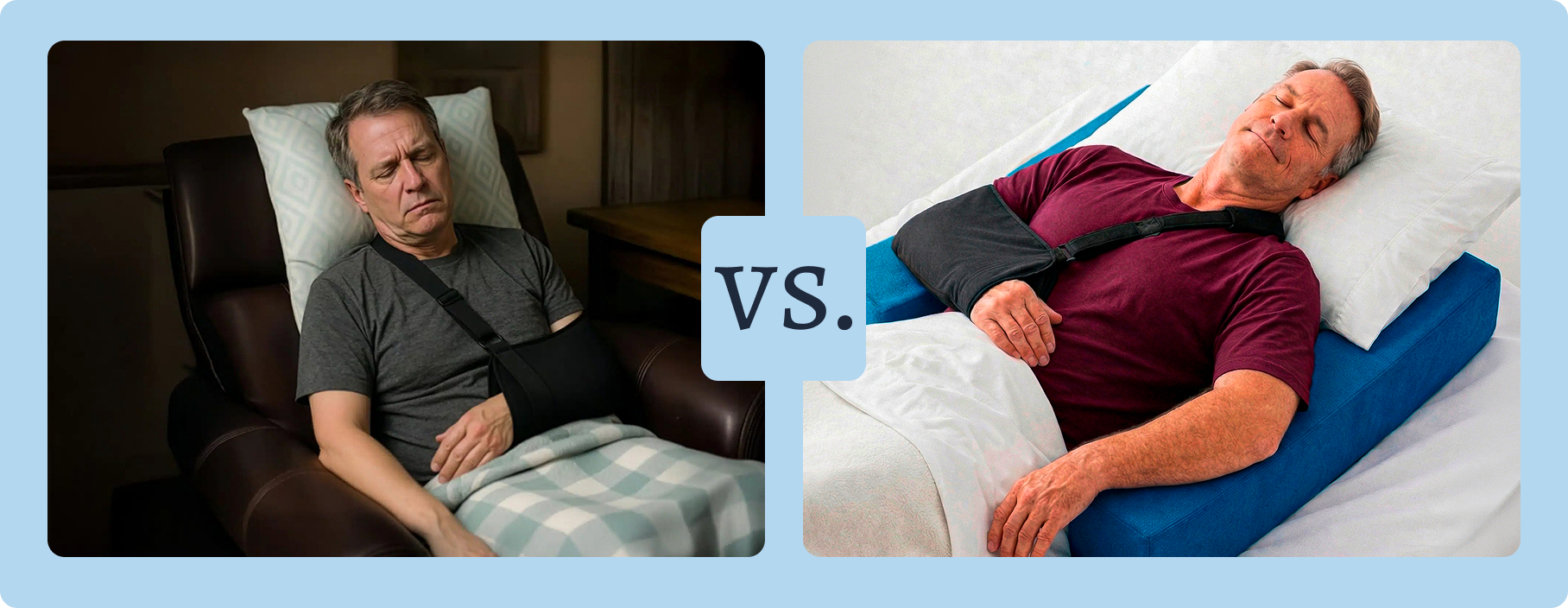
Recliner vs. Recovery Pillow After Shoulder Surgery

Which Sleep Solution Helps You Rest Better and Recover Faster?

After shoulder surgery, one of the first questions patients ask is: How am I supposed to sleep?

Whether you’ve had a rotator cuff repair, shoulder replacement, labral repair, or arthroscopic procedure, sleeping comfortably can suddenly feel impossible. Pain, swelling, immobilization, and the fear of accidentally repositioning onto your surgical shoulder often lead surgeons to recommend sleeping in an elevated position during the first several weeks of recovery.

For years, the standard solution has been a recliner.

But many patients quickly discover that sleeping in a chair comes with its own challenges. Neck pain, lower back stiffness, frequent waking, and the inability to sleep in their own bed can turn recovery into a frustrating experience. According to published research, up to 89% of rotator cuff repair patients report clinically significant sleep deprivation in the weeks following surgery. The average patient sleeping in a recliner after shoulder surgery gets only 2 hours of uninterrupted sleep per night; poor sleep actively slows recovery. 

As a result, more patients are researching the best alternative to a recliner after surgery, and discovering purpose-built therapeutic support systems designed specifically for shoulder recovery.

So which option is better? Let’s compare sleeping in a recliner versus a therapeutic recovery pillow system across the factors that matter most.

Why Sleeping Position Matters After Shoulder Surgery

Most orthopedic surgeons recommend sleeping with the upper body elevated during the early stages of recovery. Proper positioning after shoulder surgery can help reduce pain, limit swelling, and protect healing tissues.

Elevation is important because it can:

  • Reduce postoperative swelling
  • Minimize pressure on the surgical repair
  • Prevent accidental repositioning onto the surgical side during sleep
  • Improve overall comfort
  • Support proper sling positioning

The challenge isn’t understanding why elevation matters. The challenge is maintaining that position comfortably for weeks at a time.

Option 1: Sleeping in a Recliner

For decades, recliners have been the default recommendation for shoulder surgery recovery. The logic is simple: a recliner naturally keeps you upright and limits movement while sleeping.

Benefits of a Recliner

A recliner can provide:

  • Immediate elevation without stacking pillows
  • Reduced risk of repositioning onto the surgical side
  • Easier transitions from sitting to standing
  • A familiar solution many surgeons recommend

For some patients, especially during the first few nights after surgery, a recliner may feel like the easiest option.

Drawbacks of Sleeping in a Recliner

Unfortunately, many patients discover that recliners solve one problem while creating several others. Common complaints include:

  • Neck and Back Pain: Most recliners were not designed for overnight sleep. Hours spent in a seated position can create stiffness in the neck, lower back, and hips.
  • Fragmented Sleep: Many patients report waking frequently throughout the night due to discomfort, pressure points, or difficulty finding a comfortable position. Instead of getting a full night’s rest, many experience only 2 to 3 hours of broken sleep in a recliner before waking again. Recliner sleep is functional but far from restorative.
  • Isolation From the Bedroom: Sleeping in a recliner often means sleeping in a living room or separate space away from your normal sleep environment. That disruption, sleeping alone away from your partner, can be isolating and can negatively affect sleep quality and overall well-being.
  • Cost and Practicality: Purchasing or renting a recliner solely for recovery can become an unexpected expense, especially when it may only be needed temporarily.

Option 2: A Therapeutic Recovery Pillow System

An alternative approach is using a recovery support system specifically designed for shoulder surgery patients. Unlike standard wedge pillows or generic positioning cushions, therapeutic recovery systems are engineered around orthopedic positioning principles.

The Restore You Therapeutic Support was designed specifically to help patients maintain the shoulder position surgeons recommend while sleeping comfortably in their own bed.

Benefits of a Recovery Pillow System
  • Sleep in Your Own Bed: Perhaps the biggest advantage is simple: You get to stay in your own bed. Maintaining your normal sleep environment can make recovery feel less disruptive and more comfortable.
  • Better Support for the Entire Body: Purpose-built recovery systems support not only the shoulder but also the head, neck, arms, and upper torso. This reduces the compensations that often lead to secondary pain in the back and neck.
  • Maintains Therapeutic Positioning: The Restore You system is designed around the Maximally Loose Packed Position (MLPP), a shoulder position commonly used in orthopedic rehabilitation because it minimizes stress on healing tissues. Your surgeon is right to tell you that you need to stay elevated, but a recliner takes that too far. Lying in a supine position (flat on your back with a slight incline) produces better shoulder joint mechanics than an upright seated posture, including reduced pressure on the healing structures inside your shoulder.
  • Reduced Risk of Repositioning: Integrated arm supports help keep patients properly positioned throughout the night without building complicated pillow fortresses.
  • Improved Sleep Quality: According to Surgical Recovery Systems, patients using Restore You report significantly longer sleep durations compared to traditional recliner setups.

Recliner vs. Recovery Pillow: Side-by-Side Comparison

What Do Surgeons Typically Recommend?

Most surgeons aren’t necessarily recommending a recliner itself, but an elevation and protection of the shoulder. The recliner recommendation isn’t based on it being a good solution. It became the standard because, for 60 years, it was the only option available.

The actual goal has always been elevation and shoulder protection. The recliner was just the least bad way to achieve that, until now. This explains why sleeping after shoulder surgery remains the number one complaint among patients. Not the pain itself, not the sling, not physical therapy. Sleep. Because the tool surgeons have been pointing patients toward for generations was never designed for the job.

Surgical Recovery Systems built Restore You to solve the problem at its root: a purpose-engineered system that maintains the same surgeon-recommended elevation and MLPP positioning a recliner approximates, but in your own bed, for a full night’s sleep.

Most orthopedic surgeons are exceptional at fixing shoulders. The recliner recommendation persists not because it works, but because, until recently, there was nothing better to recommend. Now there is.

Which Option Is Best for You?

A recliner may make sense if:

  • You already own one
  • You only need temporary support for a few nights
  • You find upright sleeping comfortable

A therapeutic recovery pillow may be a better choice if:

  • You want to sleep in your own bed
  • You’re recovering from rotator cuff repair or shoulder replacement
  • You struggle with neck or back pain
  • You’re looking for a long-term solution during recovery
  • You want a purpose-built alternative to a recliner after surgery

For many patients, the biggest realization comes after a few nights in a chair:

Recovery is hard enough without sacrificing sleep.

Recommended Support

Sleep Better, Heal Faster

Quality sleep is part of the healing process after shoulder surgery.
While recliners have traditionally been the go-to solution, specialized recovery systems now offer patients another option: maintaining surgeon-recommended positioning while sleeping comfortably in their own bed.
If you’re researching the best alternative to a recliner after surgery, the Restore You Therapeutic Support was specifically designed to solve this challenge.
Explore the Restore You Therapeutic Support and discover how thousands of patients are recovering with greater comfort, better sleep, and more confidence.
Sleep Better, Heal Faster.

Related Clinical Articles