Expedited Shipping for $35
✦
FREE STANDARD SHIPPING IN THE U.S.
✦
SLEEP BETTER. HEAL FASTER
✦
FREE STANDARD SHIPPING IN THE U.S.
✦
Nobody warns you about this part. The surgery goes fine, the sling goes on, and then you get home and realize you have no idea how you’re supposed to sleep tonight. Your usual position is off-limits, your arm throbs the moment you lie down, and the pillows you’ve stacked around yourself keep sliding apart at 2 a.m.
This is one of the most common frustrations of shoulder surgery recovery, and it deserves more attention than it usually gets. Sleep isn’t a side issue here. It’s part of the treatment.
During deep sleep, your body shifts into repair mode. Growth hormone release is tied closely to slow-wave sleep, and that hormone plays a direct role in rebuilding tendons, muscle, and connective tissue after surgery. When sleep is cut short or constantly interrupted, that repair window shrinks along with it.
There’s also a pain connection that surprises a lot of patients. Research on total sleep deprivation has found that even one night without sleep can impair the body’s natural pain-modulation pathways and heighten sensitivity to pressure and cold.
In plain terms, the less you sleep, the more intensely you feel pain the next day, which then makes it harder to sleep the following night. It’s a loop, and it’s one of the reasons the first two weeks after shoulder surgery can feel disproportionately hard.
Sleep also supports the immune and inflammatory processes your incision depends on. People with impaired wound healing report significantly more insomnia symptoms and poorer sleep quality than those without healing complications, underscoring how tightly the two are linked.
Skimping on sleep doesn’t just leave you tired. It can slow the very process you had surgery to support.
Most surgeons recommend sleeping at an incline, generally around 30 to 45 degrees, for the first two to three weeks after rotator cuff repair, labral repair, or arthroscopic procedures. This angle reduces pressure on the repair, encourages fluid drainage to control swelling, and lowers the odds of you rolling onto the surgical side while unconscious.
For reverse shoulder replacement, the positioning stakes are a bit different because the joint mechanics themselves have been altered. Patients typically wear a sling with no active arm movement for two to six weeks, with strengthening not starting until around the three-month mark and full recovery taking four to six months. Because the deltoid, not the rotator cuff, is doing the work of moving the arm in a reverse replacement, protecting that muscle’s healing position at night matters just as much as protecting the joint itself.
Sleeping after reverse shoulder replacement generally means staying elevated and keeping the arm supported in a neutral position for longer than patients expect, since this procedure often serves people who’ve already had one surgery not go as planned.
Lying flat on your back too early is its own risk. Without elevation, swelling has less help draining, and the shoulder can drift backward into hyperextension, straining the exact structures that were just repaired.
Somewhere around three to six weeks, most surgeons will clear patients to try sleeping on the non-surgical side, provided the operated arm is stabilized in front of the body so it can’t collapse or roll forward during the night.
A shoulder wedge pillow is often the first thing people try, and it’s a reasonable starting point. It gets the torso elevated without a recliner.
But a standard wedge only solves one piece of the puzzle. It angles your back; it does nothing for your arm, which still needs independent support to stay in the position your surgeon wants, and it does nothing to stop you from rolling sideways once you’re asleep and no longer consciously holding a position.
That’s why patients so often wake up to find their arm has slipped off its pillow, or that they’ve drifted onto the surgical side without realizing it. A wedge pillow reduces the problem, but it doesn’t resolve it.
A few adjustments can meaningfully improve the nights, regardless of which surgery you had.
If pain is consistently keeping you to less than an hour of sleep at a stretch, or if you notice worsening numbness, tingling, fever, redness, or drainage at the incision, contact your surgeon. Those are signs worth addressing directly rather than working around.
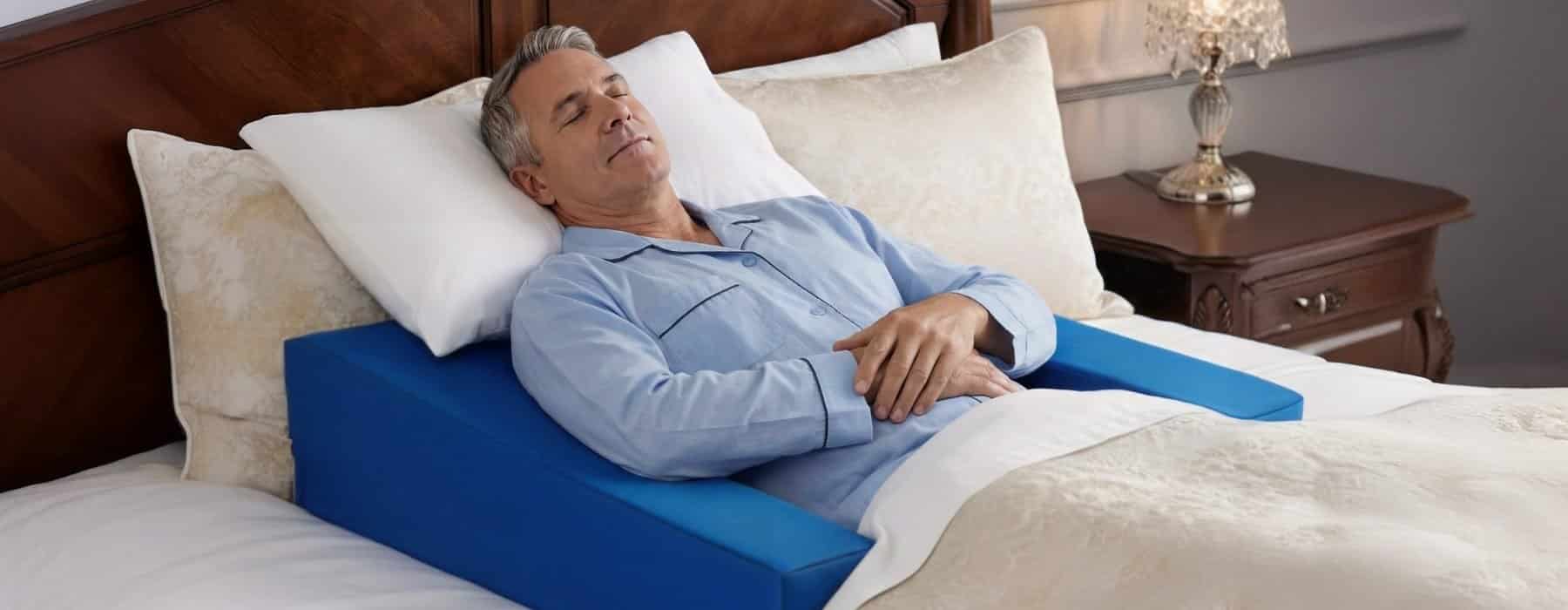
For patients who want to stay in their own bed rather than relocate to a recliner and who find that a standard wedge pillow isn’t holding their arm or preventing rolling as they need it to, a dedicated post-surgical support system is worth considering. The Restore You Therapeutic Support is built specifically for this recovery window, designed to support the torso, arm, and shoulder together rather than relying on a single incline surface. It’s intended for the weeks when positioning has to be consistent for six to eight hours straight, not just for the first restless night or two.
It isn’t a substitute for your surgeon’s specific instructions, which will vary depending on whether you had a rotator cuff repair, a labral repair, or a reverse shoulder replacement. But for the specific problem a wedge pillow can’t solve, keeping the whole body stable and the arm supported through a full night, it’s designed to close that gap.
Quality sleep is part of the healing process after shoulder surgery.
While recliners have traditionally been the go-to solution, specialized recovery systems now offer patients another option: maintaining surgeon-recommended positioning while sleeping comfortably in their own bed.
If you’re researching the best alternative to a recliner after surgery, the Restore You Therapeutic Support was specifically designed to solve this challenge.
Explore the Restore You Therapeutic Support and discover how thousands of patients are recovering with greater comfort, better sleep, and more confidence.
Sleep Better, Heal Faster.